
SILO SEO Strategy is one of the methods that online business owners have recently turned to. Based on research – especially in companies that provide services in industries outside of IT – there are now many job postings for “SEO specialists experienced in SILO SEO” in upwork or other platforms.
But the main question is: Is SILO SEO really effective? What are its pros and cons? What alternatives exist? And are all the common beliefs about SILO SEO actually true?
Table Of Contents
- 1 What is the SILO SEO Strategy?
- 2 How to Implement SILO SEO on a Website
- 3 Rule 3: Linking Within Silos
- 4 What About Multi-Section Websites?
- 5 What About Header and Footer Links in SILO SEO?
- 6 What happens if I don’t follow all the SILO SEO rules?
- 7 Advantages of SILO SEO
- 8 Disadvantages of SILO SEO
- 9 How to Solve SILO SEO Weaknesses
- 10 What is Pyramid SEO and How Does it Differ from SILO SEO?
- 11 How to Implement Pyramid SEO After Building Silos
- 12 Final Thoughts
- 13 FAQs About Everything About SILO SEO Strategy | Are the Beliefs About SILO SEO Correct or Not?
What is the SILO SEO Strategy?
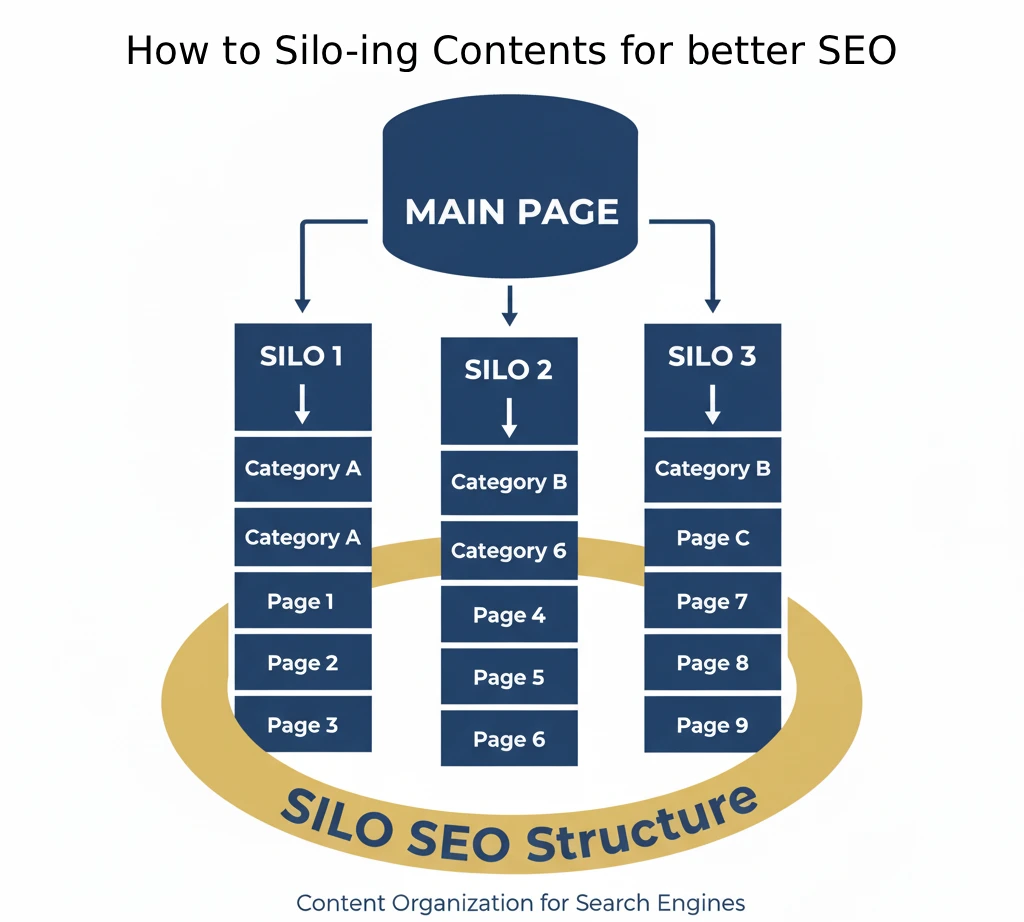
The SILO SEO strategy is a method of SEO in which the site designer or content manager creates internal links based on a specific structure, with the goal of forming different silos.
The term silo is used because it’s similar to grain or flour silos: within your site, separate silos are created, related content is placed into them, and their connections to the outside are kept very limited.
This strategy improves indexing in search engines, optimizes crawl budget, makes it easier for Google bots to read pages, and prevents infinite loops in crawling.
Although this strategy is highly useful and has many strengths, it also has weaknesses. With small adjustments, however, it can be optimized into a better model. Learning SILO SEO is an excellent addition to your SEO knowledge and lays the groundwork for stronger overall website optimization. For anyone working in SEO, mastering SILO SEO is essential.

How to Implement SILO SEO on a Website
If you are a web designer, there are a few key rules for sites using the SILO SEO strategy. Following them will help you build strong silos.
Rule 1: Neutral Pages in SILO SEO
Some pages – such as About Us or Contact Us – are considered neutral. They are usually linked from the homepage but are not part of any silo. It’s better if these pages are linked only from the homepage and from other neutral pages.
Rule 2: Creating Silo Head Pages (Head of Silo)
For every service or category you want to silo, create a dedicated Head of Silo page. This is the main page of the silo, from which other pages branch out. It’s the most important page in your silo strategy and must be chosen carefully.
Note: a Head of Silo is not the same as a category page, although categories may fall under it.
Example:
If you run a shoe store website, Women’s Shoes can be a Head of Silo. Under it, you could have categories like Women’s Running Shoes, Women’s Formal Shoes, Women’s Sandals, etc. Similarly, Men’s Shoes would form another silo with its own subcategories.
Rule 3: Linking Within Silos
When it comes to linking:
• On the homepage, link to the Head of Silo pages. (Having a full menu on the homepage, like in most e-commerce sites, won’t harm silo-ing.)
• On a Head of Silo page (for example Women’s Shoes), link only to:
– The homepage
– Sub-silos of that silo (for example Women’s Running Shoes)
– Other silo heads (for example Men’s Shoes)
You should not link to sub-silos of other silos (for example from Women’s Shoes to Men’s Running Shoes). Linking to neutral pages from silo pages is also generally discouraged.
In sub-silo pages (for example Women’s Running Shoes), links should only go to:
• The Head of Silo (Women’s Shoes)
• The homepage
• Other sub-silos of the same silo
This structure continues until the last level of content, such as a product page (Nike X Women’s Running Shoe as a product).
Following these rules builds a high-quality silo structure that search engines love.
What About Multi-Section Websites?
Some websites – like an online shoe store -may have multiple sections: a store, a blog, and a Q&A area.
For these sites, the SILO SEO strategy requires placing all different types of content into the same silos.
Example:
If you have a Women’s Shoes silo, the blog should also include a category for women’s shoe articles. Any products mentioned in those articles must also come from the Women’s Shoes silo. Articles should not link to products in the Men’s or Kids’ Shoes silos.
It’s very important to follow SILO rules in both the header and footer. You should link to neutral pages and SILO heads in these areas. However, if your website uses a mega menu that lists all categories, you should remove it from SILO pages and avoid using it within the SILO structure.
What happens if I don’t follow all the SILO SEO rules?
SILO SEO is designed based on search engine behavior, with rules created to maximize crawl budget and other SEO benefits. If you don’t follow all of the rules, the performance of your SILO strategy will drop, reducing its overall effectiveness. That said, the SILO strategy is not perfect, there is a more advanced model called the Pyramid structure, which addresses many of SILO’s weaknesses. We will cover that later in this article.
Advantages of SILO SEO
- Efficient Crawl Budget Management & Better Readability by Google Bots
The structure helps Google bots quickly find and index all relevant content within a silo. - Prevention of Infinite Loops
In large websites, bots sometimes get stuck in endless loops. SILO SEO minimizes this risk and ensures bots find more content with each crawl. - Faster Indexing for Large Websites
If your site has a lot of content, this method accelerates indexing by search engines. - Simple Implementation
Creating silos is relatively easy and doesn’t require much time for SEO specialists or site managers.
Disadvantages of SILO SEO
The main weakness is handling very similar silos. Because SILO SEO requires exclusive internal linking, some closely related content may not be cross-linked — even though it makes logical sense.
Example:
Suppose your shoe store sells the same Adidas shoe model for both men and women. According to SILO rules, you shouldn’t link the men’s product from the women’s product page. But in practice, this type of cross-linking is valuable for marketing, cross-sells, and promotions. In such cases, strict SILOing can hurt your site.
How to Solve SILO SEO Weaknesses
To address this, a newer model called the Pyramid SEO Strategy was introduced. It is based on SILO SEO but allows some flexibility, solving many of SILO’s limitations.
What is Pyramid SEO and How Does it Differ from SILO SEO?

Pyramid SEO is an improved model of SILO SEO. Many SEO experts consider it the best approach to structuring a website.
It retains the SILO system but adds new rules, such as allowing limited cross-linking between silos, which reduces the downsides while maintaining most of the benefits.
How to Implement Pyramid SEO After Building Silos
First, create your silos exactly as you would in SILO SEO – organizing content and links properly. Once silos are ready, apply the following Pyramid rules:
Rule 1: Link Between the Last Nodes of Silos
From the final content nodes of one silo, you may link to final nodes of another silo – but only if the content is highly similar.
Example: A men’s Adidas shoe and a women’s Adidas shoe of the same model, color, and style.
Rule 2: Respect Content Levels
Try to link nodes at the same level of silos. If linking at the second layer of one silo, link to the second layer of another – not higher. This keeps the pyramid structure clean.
Rule 3: Don’t Overdo It
Excessive cross-linking will destroy the silo structure, create infinite loops, and waste your crawl budget – the very problems SILO SEO was designed to solve.
Final Thoughts
SILO SEO remains one of the most reliable SEO methods for websites. By carefully structuring your silos and following the rules, you can achieve strong SEO performance.
For SEO specialists, it’s also one of the simplest yet most effective ways to deliver successful results.
We hope this article from the Koolak.net team helps you take a positive step forward in optimizing your website or your clients’ websites.
FAQs About Everything About SILO SEO Strategy | Are the Beliefs About SILO SEO Correct or Not?
Q: Is SILO SEO the best method for SEO?
A: SILO SEO is one of the most effective strategies, but it has both advantages and drawbacks. It should be used alongside other SEO strategies.
Q: What improvements will SILO SEO bring to my site?
A: It enhances how Google bots and other search engines crawl and understand your website, making indexing smoother.
Q: Is SILO SEO enough on its own?
A: No. You must also follow proper writing practices, produce high-quality content, and combine SILO with other SEO strategies.
Q: How important is content quality in SILO SEO?
A: Content quality is the foundation of all SEO. Without high-quality articles, neither SILO SEO nor any other method will help your site succeed.